

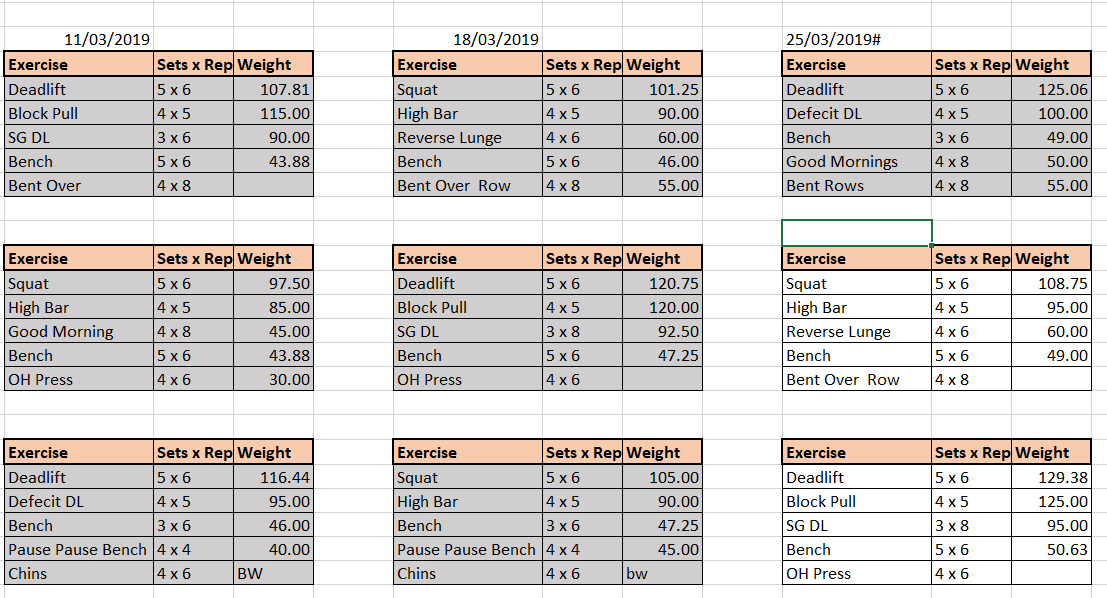
If you’re training and want to hit your targets, you’ll need a program. Training without a program is like trying to navigate the country without a map – you might end up where you need to go, but it’s unlikely and you definitely won’t take the fastest and most effective route getting there!
Despite what your friends at the gym say, or your friends on the internet there are no rights and wrongs with programmimg. Well there are, but they’re the big things like training once a week isn’t enough (obviously) and sets of 20 aren’t as effective for building strength as sets of 5 are (also pretty obvious!). To illustrate my point you only have to look at a few of the big names in powerlifting (a sport chosen for simplicity because it’s all about being strong, so the varitey in programmimg with the same end result is nice and obvious). When you’ve got programs like the bulgarian method (squatting every day – high volume, high frequency), Westside Barbell (comp lifts only done once a fortnight in certain scenarios – high variation, low freqeuncy, high load) and the lilliebridge guys (high volume of non specific accerssory bodybuilding style lifts) all producing top level lifters competing at the top of the game.
That being said there are certain elements that every training program should have. Some of the fundementals I have listed below.
Specficity: Your program needs to address the needs of the athlete (whether that’s you, or someone you’re coaching) and their sport. For instance if you need to create speed, you need to ensure that the training you are doing is going to achieve that. Every exercise included in a program should be there for a reason. If someone was to ask you why you’re doing “x” you should be able to justify it within the parameters of the program.
Progression: I have eluded to this in a previous article, but a training program needs to have planned progression embedded into it. This can be done by gradually increasing load, volume, velocity etc but whatever it is should be planned and measured. A nice simple example – you might start back squatting at 65% of 1RM for 5 x 6 at the start of your training cycle. The first 4 weeks could see this progress by 2.5% every squat session. This could be the start of a strength cycle of training. If endurance was your goal, you may set your back squats at 50% 1RM for 12, and aim to gradually increase the reps over time to 20 rep sets at the same load.
Variation: Variation is key to aviod monotony and is also important to ensure that multiple aspects of athletisim are covered in your program. Replacing a bent over row with a one arm row, for example, allows for the the benefits of unilateral training, will challenge to trunk and core in a different way and freshens the approach to training your upper back, while still achieving a strong strength stimulus. Depending on the goals of the program, periodizing through blocks of strength, speed, endurance etc may be important. This kind of variation is a touch different from simply mixing up exercises and takes a lot of planning – if your goals are multifaceted then it will be vital, but a post purely on periodization and the different ways to achive that would be as long, or longer than this post itself! So another time!
Recovery: The age old saying that you break yourself down in the gym, and grow in bed rings true. If you keep pushing and pushing you will hamper your chances of progress and increase yoiur risk of injury. Any program should have periods of rest and recovery planned into it.
Common Sense: Yep common sense. The structure of your program should make sense. If your goal is strength then the big, heavy compound lifts should be priortised with accessory working coming later. If it is speed, the you should lead with the speed work, then power, then strength work. Don’t start a session with bicep curs and end with bent over rows. Think about the impact one exercise has on another. If you want to pre-fatigue your legs by doing sets of 20 walking lunges before you squat to really hit an endurance stimulus that’s fine, as long as you are aware you’re doing it and are doing it for the right reasons.
And that’s all I’ve got time for today. Those are the basics. get them right and the other stuff will follow. It’s by no means an exhaustive list of how to plan a program (far, far from it) but stick to the principles and your program will see you getting results, not lost without a map wondering why you’re walking around in circles.